

Amorphous metal-sulphide microfibers enable photonic synapses for brain-like computing
Advanced Optical Materials, Vol.3(5) pp.635-641 (2015) - Awarded the Frontispiece Cover of the magazine - Selected as Top 10 paper of the year 2015. 05 Multimaterial optical fibres 06 Quantum & neuromorphic optics
- Citations
- 130
- Crossref, 21 November 2026
- Citing countries
- 24
- OpenAlex, 22 November 2026
- Most recent citation
- 2026
- OpenAlex, 22 November 2026
Citations per year. The shape is OpenAlex and the total above is Crossref: they index different sources, so the two numbers differ and are never added.
Abstract
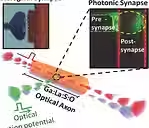
In the pursuit of all-optical brain-like computing, optical axons and photonic synapses are demonstrated using metal-sulphide microfibers, which allow the generation and propagation of optical action potentials. This gives rise to an all-optical implementation of a number of interneuronal and intraneuronal communication protocols that underlie learning and cognition in the brain.
- Published in
- Advanced Optical Materials
- Year
Where the citing work comes from
Papers from 24 countries have cited this one, led by China (80), United States (22) and United Kingdom (21). That is based on the 138 of the 142 citing papers OpenAlex records, the ones that carry an institutional affiliation. A paper written in more than one country is counted in each of them, so the table below adds up to more than the number of citing papers. Source: OpenAlex, retrieved 22 November 2026.
Hover or tap a country for its count
| China | 80 | |
|---|---|---|
| United States | 22 | |
| United Kingdom | 21 | |
| Singapore | 12 | |
| South Korea | 12 | |
| Canada | 6 | |
| Hong Kong | 6 | |
| India | 6 | |
| Germany | 5 | |
| Australia | 4 |
The other 14 countries
| Brazil | 4 | |
|---|---|---|
| Italy | 4 | |
| Pakistan | 3 | |
| Russia | 2 | |
| United Arab Emirates | 2 | |
| Uzbekistan | 2 | |
| Algeria | 1 | |
| Greece | 1 | |
| Iran | 1 | |
| Israel | 1 | |
| Japan | 1 | |
| Saudi Arabia | 1 | |
| Spain | 1 | |
| Sudan | 1 |
The 15 institutions citing it most often
- Chinese Academy of Sciences10
- Nanyang Technological University7
- University of Southampton7
- Xidian University7
- Central South University6
- Centre for Disruptive Photonic Technologies6
- Fujian Science and Technology Innovation Laboratory for Optoelectronic Information of China6
- Fuzhou University6
- National University of Singapore5
- Shenzhen University5
- Tianjin University5
- Tongji University5
- University of Chinese Academy of Sciences5
- Beijing Jiaotong University4
- Huazhong University of Science and Technology4
Source: OpenAlex, retrieved 22 November 2026.
Papers that cite this one
The 12 most recent are listed below; the newest is from 2026. Source: OpenAlex, retrieved 22 November 2026.
MATLAB® for Scientific Computing and Artificial Intelligence
Self-adaptive all-photonic synapse for autonomous neuromorphic robots
2D Perovskite All-Optical Synapses for Visual Perception Learning
Organic Phototransistor Photonic Synapses for Artificial Vision
All‐photon logic gate calculation based on phase change materials
DPP‐DTT Nanowire Phototransistors for Optoelectronic Synapses in EMG and ECG Signal Classification
Cite this paper
B. Gholipour, P. Bastock, C. Craig, K. Khan, D. Hewak, C. Soci. Amorphous metal-sulphide microfibers enable photonic synapses for brain-like computing. Advanced Optical Materials, Vol.3(5) pp.635-641 (2015). doi:10.1002/adom.201400472
BibTeX entry
@article{gholipour2015amorphous,
  title = {Amorphous metal-sulphide microfibers enable photonic synapses for brain-like computing},
  author = {B. Gholipour, P. Bastock, C. Craig, K. Khan, D. Hewak, C. Soci.},
  year = {2015},
  journal = {Advanced Optical Materials, Vol.3(5) pp.635-641 (2015)},
  doi = {10.1002/adom.201400472},
  url = {https://www.nanoscaleoptics.com/publications/10.1002-adom.201400472.html}
}
RIS entry, for EndNote, Mendeley, Zotero and RefWorks
TY  - JOUR
TI  - Amorphous metal-sulphide microfibers enable photonic synapses for brain-like computing
AU  - B. Gholipour
AU  - P. Bastock
AU  - C. Craig
AU  - K. Khan
AU  - D. Hewak
AU  - C. Soci
JO  - Advanced Optical Materials, Vol.3(5) pp.635-641 (2015)
PY  - 2015
DO  - 10.1002/adom.201400472
UR  - https://www.nanoscaleoptics.com/publications/10.1002-adom.201400472.html
AB  - In the pursuit of all-optical brain-like computing, optical axons and photonic synapses are demonstrated using metal-sulphide microfibers, which allow the generation and propagation of optical action potentials. This gives rise to an all-optical implementation of a number of interneuronal and intraneuronal communication protocols that underlie learning and cognition in the brain.
ER  -
Download every one of the 55 journal papers as BibTeX or RIS.