

Enhanced Sb2S3 crystallisation by electric field induced silver doping
Thin Solid Films, pp.80-85 (2016) 01 Material discovery 03 Optoelectronic switching
- Citations
- 20
- Crossref, 21 November 2026
- Citing countries
- 19
- OpenAlex, 22 November 2026
- First cited
- 2017
- OpenAlex, 21 November 2026
- Most recent citation
- 2026
- OpenAlex, 22 November 2026
Citations per year. The shape is OpenAlex and the total above is Crossref: they index different sources, so the two numbers differ and are never added.
Abstract
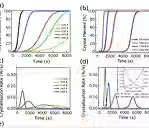
This work reveals that doping Ag into Sb₂S₃ substantially decreases its crystallisation temperature. We show that applying an electric field to Sb₂S₃ through Ag electrodes provides control of the crystallisation temperature and crystallisation rate. The crystal nuclei incubation time decreases substantially when the applied electric field is set to 200 kV/m. The applied electric field appears to force the Ag cations through the amorphous chalcogenide film resulting in Ag doped Sb₂S₃ filaments that extend from the cathode to the anode. This was confirmed by X-ray fluorescence composition mapping. Density functional theory molecular dynamics modelling of Ag doped Sb₂S₃ reveals that the diffusion constant of Ag is twice that of Sb or S over a wide temperature range, which implies that the Ag atoms are mobile in the amorphous Sb₂S₃ structure. The applied electric field provides a mechanism to enhance the crystallisation kinetics of Ag-doped Sb₂S₃.
- Published in
- Thin Solid Films
- Year
- Free copy
- Free full text
Where the citing work comes from
Papers from 19 countries have cited this one, led by Singapore (6), China (5) and United Kingdom (3). A paper written in more than one country is counted in each of them, so the table below adds up to more than the number of citing papers. Source: OpenAlex, retrieved 22 November 2026.
Hover or tap a country for its count
| Singapore | 6 | |
|---|---|---|
| China | 5 | |
| United Kingdom | 3 | |
| France | 2 | |
| India | 2 | |
| Russia | 2 | |
| Saudi Arabia | 2 | |
| Australia | 1 | |
| Denmark | 1 | |
| Finland | 1 |
The other 9 countries
| Japan | 1 | |
|---|---|---|
| Mexico | 1 | |
| Pakistan | 1 | |
| Palestine | 1 | |
| Portugal | 1 | |
| Serbia | 1 | |
| South Korea | 1 | |
| Turkey | 1 | |
| Vietnam | 1 |
The 15 institutions citing it most often
- Nanyang Technological University3
- Singapore University of Technology and Design3
- Centre National de la Recherche Scientifique2
- University of Southampton2
- Agency for Science, Technology and Research1
- Air University1
- Aix-Marseille Université1
- Arab American University1
- Atilim University1
- Autonomous University of Queretaro1
- Beijing University of Technology1
- Benemérita Universidad Autónoma de Puebla1
- Centrale Méditerranée1
- Centre Interuniversitaire de Recherche et d’Ingénierie des Matériaux1
- Centre for Disruptive Photonic Technologies1
Source: OpenAlex, retrieved 22 November 2026.
Papers that cite this one
The 12 most recent are listed below; the newest is from 2026. Source: OpenAlex, retrieved 22 November 2026.
Post-selenized strategy enhancing the performance of semitransparent Sb2S3 solar cells
High‐Chroma, High‐Contrast Tunable Color Coatings Using Sb2S3 in a Metal‐Dielectric Stack
Capping Layer Effects on Sb2S3-Based Reconfigurable Photonic Devices
Degradable mesoporous semimetal antimony nanospheres for near-infrared II multimodal theranostics
XPS study of iodine and tin doped Sb2S3 nanostructures affected by non-uniform charging
Efficient Copper‐Doped Antimony Sulfide Thin‐Film Solar Cells via Coevaporation Method
Cite this paper
W. Dong, M. Krbal, J.Kalikka, X.Y. Chin, B. Gholipour, C. Soci, P. J. Fons, K. V. Mitrofanov, L. Chen and R. E. Simpson. Enhanced Sb2S3 crystallisation by electric field induced silver doping. Thin Solid Films, pp.80-85 (2016). doi:10.1016/j.tsf.2016.07.068
BibTeX entry
@article{dong2016enhanced,
  title = {Enhanced Sb2S3 crystallisation by electric field induced silver doping},
  author = {W. Dong, M. Krbal, J.Kalikka, X.Y. Chin, B. Gholipour, C. Soci, P. J. Fons, K. V. Mitrofanov, L. Chen and R. E. Simpson.},
  year = {2016},
  journal = {Thin Solid Films, pp.80-85 (2016)},
  doi = {10.1016/j.tsf.2016.07.068},
  url = {https://www.nanoscaleoptics.com/publications/10.1016-j.tsf.2016.07.068.html}
}
RIS entry, for EndNote, Mendeley, Zotero and RefWorks
TY  - JOUR
TI  - Enhanced Sb2S3 crystallisation by electric field induced silver doping
AU  - W. Dong
AU  - M. Krbal
AU  - J.Kalikka
AU  - X.Y. Chin
AU  - B. Gholipour
AU  - C. Soci
AU  - P. J. Fons
AU  - K. V. Mitrofanov
AU  - L. Chen and R. E. Simpson
JO  - Thin Solid Films, pp.80-85 (2016)
PY  - 2016
DO  - 10.1016/j.tsf.2016.07.068
UR  - https://www.nanoscaleoptics.com/publications/10.1016-j.tsf.2016.07.068.html
AB  - This work reveals that doping Ag into Sb₂S₃ substantially decreases its crystallisation temperature. We show that applying an electric field to Sb₂S₃ through Ag electrodes provides control of the crystallisation temperature and crystallisation rate. The crystal nuclei incubation time decreases substantially when the applied electric field is set to 200 kV/m. The applied electric field appears to force the Ag cations through the amorphous chalcogenide film resulting in Ag doped Sb₂S₃ filaments that extend from the cathode to the anode. This was confirmed by X-ray fluorescence composition mapping. Density functional theory molecular dynamics modelling of Ag doped Sb₂S₃ reveals that the diffusion constant of Ag is twice that of Sb or S over a wide temperature range, which implies that the Ag atoms are mobile in the amorphous Sb₂S₃ structure. The applied electric field provides a mechanism to enhance the crystallisation kinetics of Ag-doped Sb₂S₃.
ER  -
Download every one of the 55 journal papers as BibTeX or RIS.