

Primed to remember
Science, Vol.336, pp.1515–1516 (2012) 06 Quantum & neuromorphic optics
- Citations
- 8
- Crossref, 21 November 2026
- Citing countries
- 9
- OpenAlex, 22 November 2026
- First cited
- 2015
- OpenAlex, 21 November 2026
- Most recent citation
- 2024
- OpenAlex, 22 November 2026
Citations per year. The shape is OpenAlex and the total above is Crossref: they index different sources, so the two numbers differ and are never added.
Abstract
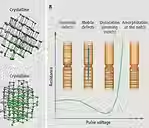
Human memory can be primed. Expose the brain, even unconsciously, to a word or object, and in subsequent exposures, the memory synapses are faster, and more details are remembered for longer times (1). Why not do the same with the electronic memories in our computers, phones, digital cameras, and game consoles? On page 1566 of this issue, Loke et al. (2) show that writing speeds in next-generation electronic memory, ones based on changing a material's phase from a crystal to a glass, have increased substantially through a preswitching incubation process. This priming enabled them to break the 1-ns barrier for electronic switching. On page 1561, Nam et al. (3) remarkably provide images and recordings of the electronic changes that occur in memory cells only a few nanometers in size that allow us to watch the switching mechanism. Both of these studies provide valuable information on the physics of phase-change memory (PCM) and also clues on how this technology could change computer architectures.
- Published in
- Science
- Year
Where the citing work comes from
Papers from 9 countries have cited this one, led by United Kingdom (6), Singapore (3) and China (2). A paper written in more than one country is counted in each of them, so the table below adds up to more than the number of citing papers. Source: OpenAlex, retrieved 22 November 2026.
Hover or tap a country for its count
| United Kingdom | 6 | |
|---|---|---|
| Singapore | 3 | |
| China | 2 | |
| United States | 2 | |
| Canada | 1 | |
| Denmark | 1 | |
| Germany | 1 | |
| Japan | 1 | |
| South Korea | 1 |
The 15 institutions citing it most often
- University of Southampton4
- Centre for Disruptive Photonic Technologies3
- Nanyang Technological University3
- The Photonics Institute2
- University of Cambridge2
- Aarhus University1
- Advanced Institute for Materials Research, Tohoku University1
- Chinese Academy of Sciences1
- Huaqiao University1
- Institute of Microelectronics1
- Jiangsu University of Technology1
- RWTH Aachen University1
- SLAC National Accelerator Laboratory1
- Shanghai Institute of Microsystem and Information Technology1
- Stanford University1
Source: OpenAlex, retrieved 22 November 2026.
Papers that cite this one
The 10 most recent are listed below; the newest is from 2024. Source: OpenAlex, retrieved 22 November 2026.
Glass transition of the phase change material AIST and its impact on crystallization
Reconfigurable Ultraviolet and High-Energy Visible Dielectric Metamaterials
Chalcogenide platforms for photonic metamaterials
Phase-change-driven dielectric-plasmonic transitions in chalcogenide metasurfaces
Classical-nucleation-theory analysis of priming in chalcogenide phase-change memory
Perspectives in in situ transmission electron microscopy studies on lithium battery electrodes
Amorphous Metal‐Sulphide Microfibers Enable Photonic Synapses for Brain‐Like Computing
Cite this paper
D. W. Hewak and B. Gholipour. Primed to remember. Science, Vol.336, pp.1515–1516 (2012). doi:10.1126/science.1223365
BibTeX entry
@article{gholipour2012primed,
  title = {Primed to remember},
  author = {D. W. Hewak and B. Gholipour},
  year = {2012},
  journal = {Science, Vol.336, pp.1515–1516 (2012)},
  doi = {10.1126/science.1223365},
  url = {https://www.nanoscaleoptics.com/publications/10.1126-science.1223365.html}
}
RIS entry, for EndNote, Mendeley, Zotero and RefWorks
TY  - JOUR
TI  - Primed to remember
AU  - D. W. Hewak and B. Gholipour
JO  - Science, Vol.336, pp.1515–1516 (2012)
PY  - 2012
DO  - 10.1126/science.1223365
UR  - https://www.nanoscaleoptics.com/publications/10.1126-science.1223365.html
AB  - Human memory can be primed. Expose the brain, even unconsciously, to a word or object, and in subsequent exposures, the memory synapses are faster, and more details are remembered for longer times (1). Why not do the same with the electronic memories in our computers, phones, digital cameras, and game consoles? On page 1566 of this issue, Loke et al. (2) show that writing speeds in next-generation electronic memory, ones based on changing a material's phase from a crystal to a glass, have increased substantially through a preswitching incubation process. This priming enabled them to break the 1-ns barrier for electronic switching. On page 1561, Nam et al. (3) remarkably provide images and recordings of the electronic changes that occur in memory cells only a few nanometers in size that allow us to watch the switching mechanism. Both of these studies provide valuable information on the physics of phase-change memory (PCM) and also clues on how this technology could change computer architectures.
ER  -
Download every one of the 55 journal papers as BibTeX or RIS.